Symbols of Heraldry
The parts a coat of arms is built from.
A coat of arms is not a freely painted picture but a kit with fixed parts and fixed rules. Every entry on this page names the meaning of the sign and the families who choose it. Once you know the parts, you can see in your own coat of arms why it looks the way it does.
The structure
The full achievement and its six parts.
What people commonly call a “coat of arms” is, strictly speaking, the full achievement: shield, helm and everything that belongs to them.
- 1
The shield
The heart of it. It carries the tinctures, the partition and the charges. Everything else is arranged around it.
Comes from: the places and regions your family comes from
- 2
The helm
Above the shield stands a closed helm, plain in form. Every coat of arms we make carries one.
Comes from: the same for every coat of arms
- 3
The torse
The twisted wreath on the helm, always in the two principal tinctures of the shield. It joins helm and crest.
Comes from: follows automatically from the shield tinctures
- 4
The mantling
The cloth falling from the helm. It takes up the principal colour and metal of the shield, never other tinctures.
Comes from: follows automatically from the shield tinctures
- 5
The crest
The figure upon the torse. It is the point of the coat of arms: the one sign that stands above everything.
Comes from: your values
- 6
The motto scroll
The band beneath the shield. It carries the motto, if you want one; a coat of arms is complete without it.
Comes from: your motto
The tinctures
Four colours, two metals, and the furs.
Every coat of arms is composed from these tinctures, there are no intermediate shades, no gradients and no pastels.
Red, Gules
Colour
Meaning: Courage, valour, willingness to sacrifice, and love. The tincture that carries furthest.
Chosen by: Families of soldiers, firefighters, smiths, and by all who place defence at the beginning of their story.
Blue, Azure
Colour
Meaning: Loyalty, constancy, truthfulness; also sky and water.
Chosen by: Seafaring and fishing families, houses of coasts and river courses, and wherever reliability across generations is the core of the story.
Green, Vert
Colour
Meaning: Hope, freedom, growth, the land itself.
Chosen by: Farmers, foresters, hunters, wine growers, and by families who never left their land.
Black, Sable
Colour
Meaning: Constancy, gravity, prudence, and also grief and humility.
Chosen by: Scholars, clergy, miners, and by families whose history holds a loss that should not be painted over.
Gold, Or
Metal
Meaning: Generosity, wisdom, warmth; the sun. The first of the tinctures.
Chosen by: Families who bore responsibility for others, in office, in the guild, in the parish.
Silver, Argent
Metal
Meaning: Sincerity, purity, peace; the moon.
Chosen by: Families whose reputation is built on honesty, and wherever a quiet field should carry the charge.
Rare and particular
Purple, Purpure
Colour
Meaning: Dignity and dominion.
Chosen by: almost no one, in German heraldry purple appears only on hats, coronets, mantles and helm linings, never as a field tincture.
Ermine, white field with black tails
Fur
Meaning: Dignity and high rank; the fur that lined princely mantles.
Chosen by: Rarely in a burgher coat of arms, where it easily looks presumptuous.
Vair, blue and white bell pattern
Fur
Meaning: Wealth and the age of a house; the most common fur of medieval heraldry, taken from the back of the northern squirrel.
Chosen by: old burgher families who won standing through trade and reputation, not by birth.
Plain fur, Kürsch, natural-coloured fur
Fur
Meaning: Groundedness and the great age of a coat of arms.
Chosen by: houses whose coats of arms date from the earliest age of heraldry.
The rule of tincture
Never colour on colour, never metal on metal. Red on blue is wrong, gold on silver just as much, at a distance both blur together. Red on gold is right. This rule is older than any taste, and it outranks your colour wish too: name two tinctures that may not sit side by side, and the rule decides.
Red on blue
Colour on colour, at a distance both blur together
Red on gold
Colour on metal, carries a hundred paces
The only exception is fur; it counts neither as colour nor as metal and may border both.
The partition
How the shield is divided.
Before a charge enters the field, the shield is divided. The partition tells the origin: two lines, two landscapes, a road, a river.
Per pale
Meaning: Divided vertically into two halves, two origins side by side.
Chosen by: Families from two lines, two countries, two confessions.
Per fess
Meaning: Divided horizontally, often origin above, present below.
Chosen by: Families who carry a break in their history, before and after, origin above, present below.
Quarterly
Meaning: Into four fields, several lines in one shield.
Chosen by: Families in which several coats of arms have come together, by inheritance or marriage.
Chief
Meaning: A band along the upper edge: a place that stands above everything.
Chosen by: Families with a place or an honour that stands above all the rest.
Bend
Meaning: A band from upper left to lower right: a road travelled.
Chosen by: Families who moved, emigration, migration, a journey.
Wavy line
Meaning: An undulating division, water, coast, river.
Chosen by: Families on a river, coast or harbour; millers, boatmen, fishermen.
Embattled line
Meaning: Wall and defence, the fortified town.
Chosen by: Families of burghers and councillors, builders, town officers.
Dancetty line
Meaning: Forest and mountains.
Chosen by: Families from wooded country, woodcraft, charcoal burning, forestry.
Base
Meaning: The ground everything stands on, soil, homeland.
Chosen by: Families who want an origin set beneath the image rather than above it.
The ordinaries
The geometric base figures.
Ordinaries are the geometric base figures. They always reach the edge of the shield and are older than any beast or tool in heraldry: the plainest and oldest of signs.
Pale
Meaning: Steadfastness, the upright spine of a family.
Chosen by: Families who have held their ground in one place across generations.
Fess
Meaning: The knight's belt; measure, order, obligation.
Chosen by: Families with office and duty, judges, administrators, guild masters.
Chevron
Meaning: House, building and shelter.
Chosen by: Carpenters, masons, master builders, and by anyone who founded a house that others live in.
Cross
Meaning: Faith, pilgrimage, service to the church.
Chosen by: Families with clergy, with a pilgrimage or a crusade in their tradition.
Bend
Meaning: The path running across the field from top to bottom, departure and migration.
Chosen by: Emigrant families, carters, merchants on long roads.
Bordure
Meaning: Enclosure and protection; also the classic mark of difference for a younger line.
Chosen by: Cadet lines that set themselves apart without leaving the family coat of arms.
Pile
Meaning: Mountain and ascent, a direction everything points towards.
Chosen by: Families from highland country, and where a rise carries the story.
Canton
Meaning: An honour or a connection that came later.
Chosen by: Families who want to show a distinction or a second inheritance.
Pall
Meaning: Three strands brought together in one point.
Chosen by: Families with three origins.
The charges
What stands in the shield.
Charges are the signs in the field. They come from the work your family is connected to.
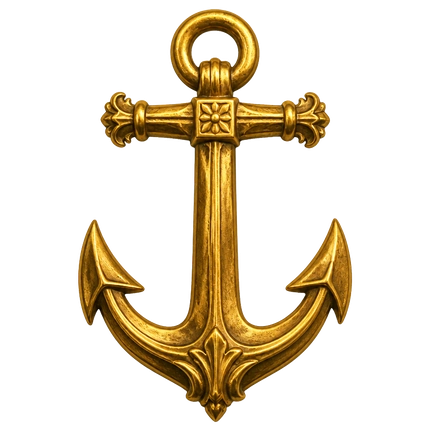
Anchor
Meaning: Sea, harbour, hold, what holds fast when the storm comes.
Chosen by: Seafaring, pilot and harbour families, and wherever constancy through change counts.
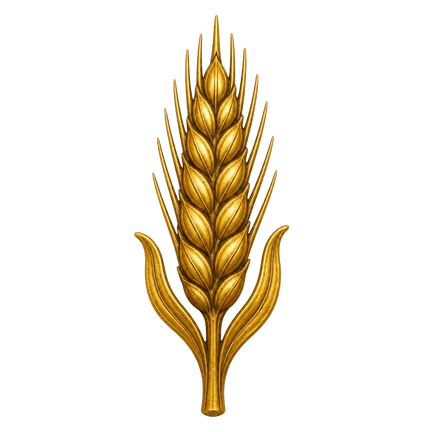
Wheat sheaf
Meaning: Land, harvest, husbandry, yield won by one's own work.
Chosen by: Farming, milling and wine-growing families with a long bond to one stretch of land.
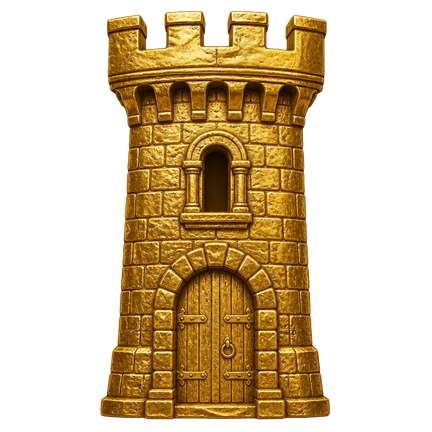
Tower
Meaning: Shelter, town, permanence: a structure that outlives generations.
Chosen by: Burgher and council families, master builders, families from walled towns.
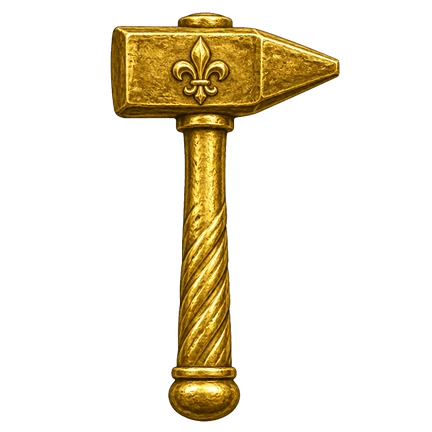
Hammer
Meaning: Craft, forge, building: the yield of the hand.
Chosen by: Smiths, miners, carpenters and guild families.
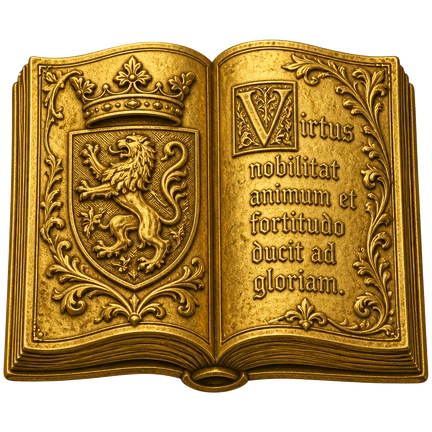
Book
Meaning: Teaching, law, knowledge, passing on rather than owning.
Chosen by: Families of scholars, teachers, lawyers and clergy.
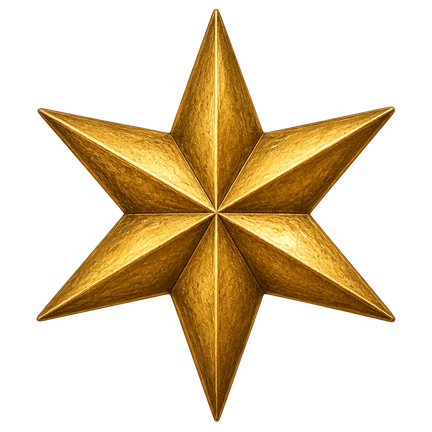
Six-pointed star
Meaning: Guidance and constancy; often one star for each member of the family.
Chosen by: Families who want to record a number in their coat of arms, children, lines, farmsteads.
Stars in continental heraldry have six points, not five. There are many such settled points, they are the reason a coat of arms looks like heraldry and not like a logo.
The postures
How charges stand in the field.
The same charge says something different depending on how it stands. The posture is always named in the blazon, it is part of the coat of arms, not a matter for the artist.
Palewise (upright)
Meaning: The default posture: the charge stands vertically, point upward. Unless something else is said, this applies, readiness, defence, an upright stand.
Chosen by: almost every family; a blazon stays silent here, because upright is the normal case.
Fesswise (lying)
Meaning: The charge lies horizontally. Rest rather than attack: a tool set down, a road leading aside.
Chosen by: Families who want to show craft and peace, not weapons.
Bendwise
Meaning: Diagonally from upper left to lower right. Movement and departure; the most common posture for staves, arrows and tools.
Chosen by: Families who migrated, carters, merchants, emigrants.
Inverted
Meaning: The charge stands on its head, point downward. Not a reversal into the negative, but ending, peace and reflection: the sword laid down.
Chosen by: Families recording a conclusion: return, reconciliation, the end of a war.
In saltire
Meaning: Two identical charges crossed diagonally. The unity of two forces that support one another.
Chosen by: Families from two crafts, two lines or two farmsteads.
Placed 2:1
Meaning: Three identical charges, two above, one below. The classic arrangement for threes, without it the shield looks restless.
Chosen by: Families with three sons, three lines, three farms; the number is the message, not the sign.
Accompanied
Meaning: One principal charge with smaller ones beside it. The main sign carries the story, the companions count: children, generations, places.
Chosen by: Families who want a number set beside their principal charge.
Respectant and addorsed
Meaning: Two charges face one another or turn away. Facing means bond and union, turned away the parting of two lines.
Chosen by: Families who carry the marriage of two houses or two branches of one family in the image.
Dexter and sinister always count from the view of the bearer behind the shield. What lies to your left as a viewer is heraldic dexter: the side of honour, where the older sign stands.
The helmets
The helm above the shield.
A helm always stands above the shield. Here you see the forms heraldry has drawn over the centuries.
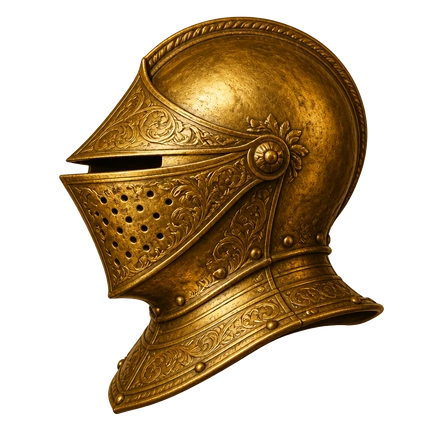
Tilting helm, Stechhelm, closed tournament helm
Meaning: Readiness to defend, without a claim to rank. The burgher helm of German heraldry: closed and plain in form.
Chosen by: Almost every newly assumed coat of arms; it is the standard form at StemmaCrest.
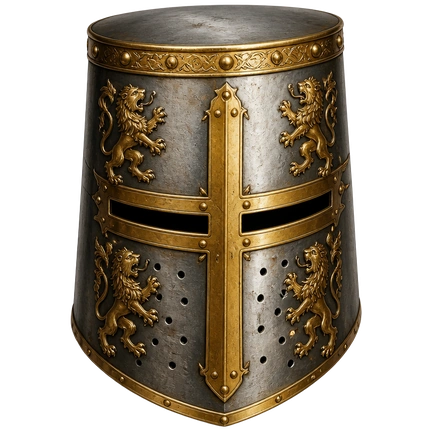
Great helm, Topfhelm, bucket helm
Meaning: The oldest helm in heraldry, flat-topped, with a cross-shaped sight slit. It points to the earliest age of heraldry and to crusading tradition.
Chosen by: Ancient houses whose coats of arms date from the 13th century, and families with a crusader tradition.
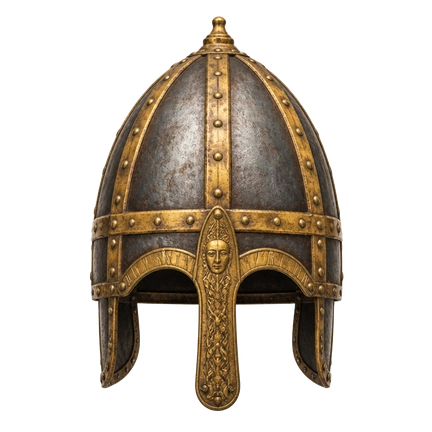
Nasal helm, Spangenhelm, nasal helm
Meaning: A conical early form with a nose guard, riveted from iron bands. It stands for descent from pre-heraldic times.
Chosen by: Families with a Nordic or early medieval origin story, usually as a quotation.
Every coat of arms we make carries a closed helm. That is not a fallback but the correct form for a burgher coat of arms.
The crest
The sign above the helm.
Crest, torse and mantling together form the upper part of the coat of arms, the part that was seen from afar at the tournament, and the part that shows today whether a coat of arms grew or was assembled.
The torse, wreath
Meaning: A twisted ring of cloth in the two principal tinctures of the shield, joining helm and crest. Six visible turns are the rule, beginning with the metal.
Chosen by: every coat of arms we make; the crest rests on it.
The mantling, lambrequin
Meaning: The tattered cloth falling from the helm, originally protection from the sun over armour, its cuts read as traces of battle. Colour outside, metal of the shield within.
Chosen by: every full achievement; without mantling the helm looks bare. Its tinctures always repeat the shield.
The plume, ostrich feathers
Meaning: Three feathers in the shield tinctures, upright from the torse. The plainest crest, dignity without a claim.
Chosen by: Families whose shield already tells the whole story and who want nothing added above the helm.
The buffalo horns, open horns
Meaning: Two curved horns left and right, usually divided in the shield tinctures. An ancient German crest: strength, defence, the holding together of two sides.
Chosen by: old German houses and families from stock rearing, farmland and border regions.
The wings, closed or open flight
Meaning: A pair of eagle wings. Open means departure and distance, closed means return and the protection of one's own.
Chosen by: Families with emigration, seafaring or a fresh start in their tradition.
The issuant figure, issuant, demi-figure
Meaning: A person or animal appears only from the waist up, as if growing out of the helm. The strongest form of crest, because it carries a gaze.
Chosen by: Families with a founding forebear, a figure of their trade, or a beast already standing in the shield.
The repeated shield charge, crest drawn from the shield
Meaning: The principal charge of the shield returns above the helm: the cleanest and most common solution, because shield and crest then make one statement.
Chosen by: most newly assumed coats of arms; the de Buhr, too, bear their tower above the helm.
The screen board, Schirmbrett, fan
Meaning: A painted board or fan behind the helm, often set with feathers or linden leaves. A sign from the age of tournaments.
Chosen by: Families who wish to stress a period or a region, southern Germany, Switzerland.
The mantling always repeats the two principal tinctures of the shield: the colour outside, the metal within. Introduce a third tincture here and the coat of arms tears into two pictures.
The accessories
Supporters, motto, mantle.
Everything standing outside shield and helm belongs, strictly speaking, not to the coat of arms but to its setting. It may be dropped without the coat of arms becoming a different one, and most of it should be.
The supporters, tenants, supporters
Meaning: Two figures or beasts flanking the shield. Historically a mark of high rank, in Germany reserved for princes, towns and corporations.
Chosen by: virtually no burgher family. We do not use them, they would be a quiet claim to rank.
The motto, devise, scroll
Meaning: A short sentence on a band beneath the shield, often in the language of one's origin. It is not part of the coat of arms in the strict sense and may therefore be changed freely.
Chosen by: Families with a sentence handed down across generations, three to five words carry, a whole paragraph does not.
The mantle, robe of estate, pavilion
Meaning: A purple, ermine-lined mantle behind the whole achievement. A princely display piece, not a component of the coat of arms itself.
Chosen by: reigning houses, in a burgher coat of arms it is simply wrong.
The compartment, base, ground
Meaning: A ground beneath the shield, turf, rock, a stone plinth, so that supporters and scroll can stand. Purely pictorial, with no heraldic meaning.
Chosen by: coats of arms that hang on a wall as a picture; on a seal or a stamp it is simply left out.
The collar of an order, collar, insignia
Meaning: An order placed around the shield. Admissible only if it was truly conferred on you personally, and it is not inherited.
Chosen by: individuals with a distinction, in a family coat of arms passed on to children it has no place.
Banners and standards, flag, ensign
Meaning: The content of the shield transferred to rectangular cloth. A derivation of the coat of arms, not an additional sign: the crest is omitted.
Chosen by: Families with a farm, a house or a boat burgee who want their sign on cloth as well.
The test: whatever would no longer be visible on a signet ring is trimming. Shield, helm, mantling and crest remain: the rest adorns the letter of arms. We deliver the coat of arms with its letter of arms. The ring is one of the things our partners make from it.
The blazon
How a coat of arms is put into words.
The blazon is the binding description. The coat of arms is not the picture but this text: from it any herald can draw the coat of arms anew, and two drawings of the same wording are the same coat of arms.
The order is fixed
1. Field and partition
The ground of the shield first: “Gules”, “Party per fess argent and azure”.
2. Ordinary
Then the geometric base figure: “a fess or”.
3. Charges
Next the signs in the field, with number, tincture and posture: “three wheat sheaves argent, placed 2:1”.
4. Secondary charges
What accompanies the principal charge: “accompanied by two six-pointed stars”.
5. Helm and mantling
The crest group: “On the helm, with mantling gules and argent …”.
6. Crest
Finally the crest itself: “… a tower argent issuant.”
An example
“Gules, an anchor argent crossed by an axe argent, accompanied by two wheat sheaves or and two six-pointed stars or; on the tilting helm with mantling gules and argent, a tower argent issuant.”
Two clauses, divided by a semicolon: first the shield, then what stands above it. No sizes, no arrangement notes that go without saying, whatever is not stated is left to the artist.
Terms that keep returning
dexter / sinister
Always from the bearer's view behind the shield, reversed for the viewer.
gules
The field tincture, always named first and always without an article.
charged with
One figure lies upon another.
accompanied by
Smaller figures beside the principal charge.
issuant
The figure appears only from the upper half.
guardant
The head is turned towards the viewer.
between
A figure stands in each angle of a cross or chevron.
ensigned by
One figure stands above another without touching it.
The rules
What is allowed and what is not.
Heraldry is not a matter of taste with exceptions but a craft with a few hard rules. They grew out of use: a coat of arms had to stay recognisable in the field, at a distance, and in a wax seal.
The rule of tincture comes first
Meaning: Never colour on colour, never metal on metal. It is not a question of taste but the reason a coat of arms stays legible at a hundred paces.
Chosen by: everyone, without exception. If a colour wish collides with the rule, the wish yields, not the rule.
Few signs
Meaning: One to three charges carry a coat of arms. Put the whole family history into the shield and you get a picture no one can read.
Chosen by: every good design. What does not fit in the shield belongs in the letter of arms, not in the image.
No lettering and no dates
Meaning: Letters, names and numbers do not belong in the shield. They are legible only once you stand close enough, and by then the coat of arms is no longer needed. That is why the motto sits on the scroll, not in the field.
Chosen by: no heraldically sound coat of arms, universities are the exception.
No perspective, no gradients
Meaning: Charges are drawn flat and formulaically, not naturalistically. The lion is a heraldic lion, not a zoo animal. Depth comes from execution in gold, stone or wax, not from shading in the drawing.
Chosen by: everyone. This is exactly where a coat of arms parts company with logos and invented fantasy.
A burgher coat of arms stays plain
Meaning: Every coat of arms we make carries the closed helm and the torse, without supporters or mantle. A burgher coat of arms with princely trappings is not a compliment but a mistake.
Chosen by: everyone. The closed helm is not a fallback but the correct form.
The mark of difference, brisure of a cadet line
Meaning: Where several lines inherit the same coat of arms, the younger changes a detail: a bordure, a label, a different tincture in the crest. That way both stay distinguishable.
Chosen by: cadet lines that set themselves apart without leaving the stem.
No sovereign emblems
Meaning: The coats of arms of states, cities and sovereigns, national eagles, provincial coats of arms and orders may not be taken into a family coat of arms, not even in altered form.
Chosen by: no one. A home town is quoted through tinctures and charges, never through its coat of arms.
A coat of arms must be new
Meaning: It may not repeat an existing coat of arms. A shared surname alone does not entitle anyone to bear an old family's coat of arms, that requires unbroken proof of descent.
Chosen by: every new design. We check each one against the historic coats of arms we hold.
The coat of arms belongs to the family
Meaning: They are borne by the founder and his descendants. They are not a personal mark but one that is handed on, and therefore they tolerate no fashion.
Chosen by: everyone who designs for grandchildren and not for themselves.
We tell you when a wish runs against one of these rules, before the drawing, not after. That is the difference between a coat of arms and a picture that looks like one.
The law
Who a coat of arms belongs to.
More legends than statutes circulate about German armorial law. The position is simpler than it sounds, and less ceremonious.
Anyone may bear a coat of arms
Meaning: In Germany the capacity to bear a coat of arms is not tied to station or descent. Every person and every family may assume their own coat of arms, as long as it is not already borne by another family.
Chosen by: everyone, burgher coats of arms are documented in central Europe since the 13th century.
No authority grants them
Meaning: Since the end of the monarchy in 1918 there has been no body in Germany that grants or approves burgher coats of arms. A coat of arms comes into being through assumption and use, not through a decision.
Chosen by: every new assumption. Anyone selling you a “grant from an authority” is selling something that does not exist.
Protection comes from the law of names
Meaning: A coat of arms counts as the mark of a family and is protected like a name under § 12 of the German Civil Code: anyone bearing it without authority can be required to desist.
Chosen by: every family that demonstrably and continuously bears its coat of arms: the proof is the decisive part.
The drawing is protected separately
Meaning: The coat of arms itself, that is, the blazon, falls under the law of names. The particular artistic drawing is separately protected by copyright. The two do not coincide.
Chosen by: all of our clients: you receive the rights to the depiction of your coat of arms without restriction.
Entry in a roll of arms
Meaning: A register grants nothing, it proves: it records blazon, image, founder and date, and publishes them. That makes it possible to show, in a dispute, since when a family has borne the sign: the practical core of protection.
Chosen by: every family who wants their coat of arms secured for good. On request we enter it in our own roll of arms.
The legal basis in full: § 12 of the German Civil Code (law of names) and Article 109 (3) of the Weimar Constitution, still in force through Article 123 of the Basic Law. This page reflects settled practice and is not legal advice.
The mapping
Which answer determines which element.
So that nothing seems arbitrary: every question in the interview has its place in the coat of arms.
Your family name
an allusion in the image: the canting coat of arms
Where your family comes from
the field and partition of the shield
The work your family is connected to
the charges in the shield
How many of you there are
how often a charge appears
Your values
the crest and further charges
Your choice of colours
a wish: the rule of tincture comes first
Your motto
the text on the scroll
The mapping is a rule, not a formula. Exactly how a trade becomes a charge is decided in the design, which is why you receive three proposals rather than one.